Key Takeaways
1. You can program a key fob yourself only on certain older cars or when you already have two working keys, while most push-to-start and transponder keys need professional equipment.
2. A fob does two jobs: opening the doors and starting the engine, and the starting part is almost never DIY-friendly on newer cars.
3. Great Valley Lockshop programs smart keys, transponder keys, and remotes on-site across PA, NJ, DE, and MD, so you don’t need a tow or a dealer appointment.
What is Key Fob Programming
You can do key fob programming yourself on some older cars and on models that let you add a key with two working ones. Most push-to-start smart keys and transponder keys need a diagnostic tool and security codes, so those jobs go to an automotive locksmith or dealer.
Many online guides make it sound like every car follows the same five-step routine. That’s why so many drivers end up with a fob that locks the doors but won’t start the engine. Before you try it, find out which group your car is in.
What Key Fob Programming Actually Does
Key fob programming teaches your car to recognize a specific fob and reject every other one. On most cars built since the late 1990s, that involves two separate systems, and push-to-start cars add a third.
Remote Keyless Entry (RKE)
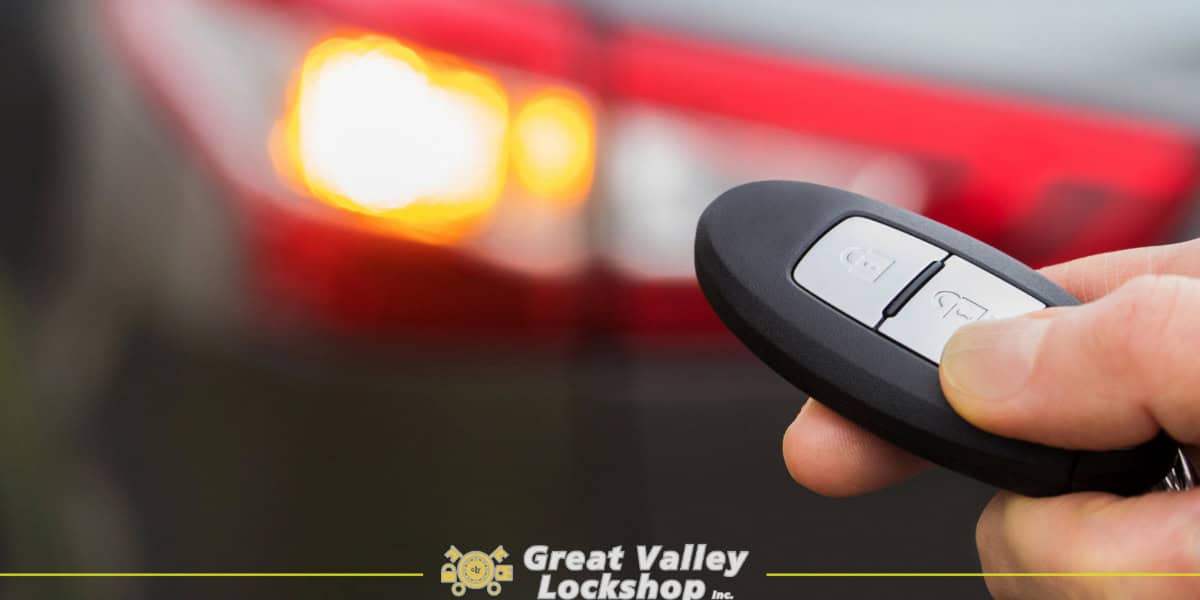
Remote keyless entry covers the buttons that lock, unlock, and open the trunk. When you press a button, the fob sends a short radio signal, usually on the 315 MHz band in North America.
Most systems use rolling codes, so the signal changes every time you press a button. That stops thieves from recording the signal and replaying it later. Programming the remote means syncing it with the car’s receiver so both sides agree on the code.
On many older cars, owners can do this part themselves with a sequence from the owner’s manual. It often involves turning the ignition on and off or pressing the lock button within a set number of seconds.
Immobilizer and Transponder Chip
The immobilizer is the anti-theft system that decides whether the engine can start. It only lets the engine run when it detects a programmed transponder chip in the key.
The chip doesn’t need a battery. An antenna rings around the ignition, or near the start button, powers it briefly and reads its code. If the code matches, the engine starts. If not, the car may crank but won’t run.
This is why the immobilizer is harder to program. It’s the main thing standing between a thief and your car, so automakers deliberately limit who can add a key. On most models, pairing a new chip requires a diagnostic tool, the car’s security code or two keys the car already recognizes.
Smart Key Systems on Push-to-Start Cars
Push-to-start cars use a smart key, also called a proximity key. Antennas in the doors and cabin sense when the fob is nearby, so you can unlock the door and start the car without pressing anything.
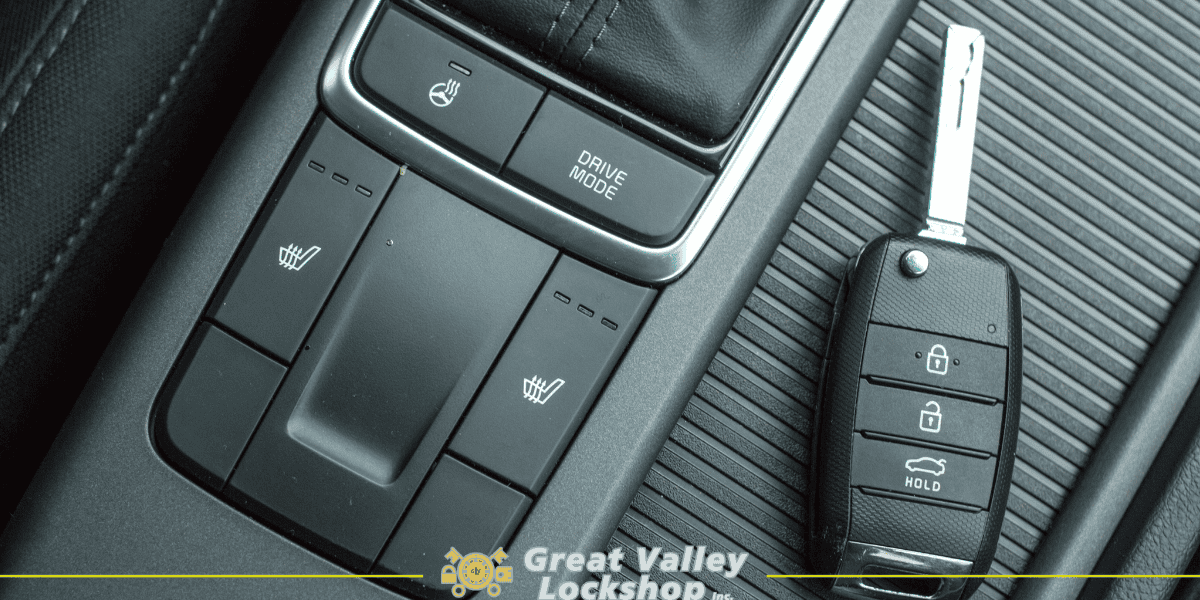
A smart key combines all three functions in one fob: remote buttons, proximity sensing, and an immobilizer chip. All of them are tied to the car’s security system, so programming one almost always requires professional equipment connected to the OBD-II port.
On older cars, the remote is often the only part an owner can program. The chip that starts the engine is a security feature, so automakers make it harder to add.
Key Fob Replacement in PA From Start to Finish
Can You Program a Key Fob Yourself?
Sometimes, yes. It depends on three things: the key type, the car’s age, and how many working keys you have.
| Key type | DIY possible? | Why |
|---|---|---|
| Separate remote on an older car | Usually | Many manuals list an onboard pairing sequence |
| Remote head key, remote side only | Sometimes | The buttons may pair, but the chip may not |
| Transponder key, two working keys on hand | Sometimes | Some models, including certain Fords, allow it |
| Transponder key, one or no working keys | Rarely | Needs a diagnostic tool and key codes |
| Push-to-start smart key | Rarely | Needs a diagnostic tool and the security code |
| Some European models | No | Some brands, such as Mercedes-Benz, keep new keys largely dealer-only |
Age matters because systems have gotten stricter over time. “If you have a car that’s 10 years or older, it’s more likely you will be able to use an aftermarket key fob,” says our auto locksmith.
Not sure where your car fits? Call Great Valley Lockshop with your year, make, and model, and we’ll tell you whether it’s a DIY job.
How Key Fob Programming Works, Step by Step
You can program a key fob in two ways: the DIY routine in your owner’s manual or professional programming with diagnostic equipment. Seeing both side by side shows why most drivers end up calling a professional.
The DIY Method and Where It Stops
If your car supports self-programming, the routine usually looks like this:
- Match the fob. Check that the FCC ID and part number on the back match your original. A fob on the wrong frequency will never pair.
- Gather every key. Many cars clear the remote buttons but not the transponder chip, so a lost key can still start the car.
- Enter programming mode. Sit inside with the doors closed, then follow the manual’s sequence, such as turning the ignition on and off several times within a few seconds.
- Press the buttons in order. The car usually confirms with a chime or by cycling the locks.
- Test the engine start. This is where many DIY attempts fail.
This routine usually pairs only the remote buttons. Adding the transponder chip that starts the engine typically requires two working keys, and on most push-to-start cars it isn’t possible at all.
DIY also comes with risks:
- Mistimed steps can make the car drop remotes that were already working.
- Online fobs may be the wrong frequency or locked to another car, and you usually can’t return them once programmed.
- Repeated failed attempts waste the fob, your time, and sometimes a dead car battery.
- Lost keys stay active because DIY routines can’t erase a missing fob from the car’s memory.
The Professional Method
Professional programming covers the whole job, not just the buttons. Here’s what a Great Valley Lockshop technician does:
- Verify ownership. We check your photo ID against your title, registration or lease, so nobody else can get a key to your car.
- Decode the VIN. Your vehicle identification number (VIN) tells us the exact fob, chip and frequency your car needs, so there’s no guesswork.
- Retrieve the security code. We use credentialed access through the National Automotive Service Task Force (NASTF), which logs every key code request.
- Cut the blade. If your fob has an emergency key, we cut it to match your locks.
- Program through the OBD-II port. Our diagnostic tool connects to the socket under the dashboard and pairs the remote, the transponder chip, and smart key functions in one session.
- Erase lost keys. We remove any missing fob from the car’s memory, so it can no longer unlock or start the car.
- Test everything with you. Lock, unlock, trunk, panic, proximity entry, and engine start are all checked before we leave.
DIY vs. Professional at a Glance
| DIY programming | Professional programming | |
|---|---|---|
| Remote buttons | Often, on older cars | Yes |
| Transponder chip | Only with two working keys on some models | Yes |
| Push-to-start smart keys | Rarely | Yes, on most makes |
| All keys lost | No | Yes |
| Erasing lost or stolen keys | No | Yes |
| Fob matched to your VIN | Up to you | Confirmed before programming |
| If something goes wrong | You start over | The technician resolves it on-site |
DIY can work for a simple remote on an older car. For anything that starts the engine, a professional gets it done right the first time.
Great Valley Lockshop comes to your home, office, or roadside, so you won’t need a tow or a dealer appointment. Call (610) 644-5334 with your year, make, model, and VIN, and we’ll confirm the right fob before we arrive.
Professional Key Fob Programming From Great Valley Lockshop
Programming a key fob yourself makes sense for a simple remote on an older car. Once the job involves the transponder chip, a push-to-start smart key, or a lost key, it takes diagnostic equipment, security access, and a proper ownership check. A failed DIY attempt can leave your car unable to start, while a lost fob can still open it.
Great Valley Lockshop handles the programming jobs you can’t do at home. Our auto locksmith team works on transponder keys, remote head keys, flip keys, and push-to-start smart keys, right where your car is parked.
Three Steps to a Working Fob
1. Check what your car allows. Look in your owner’s manual for a key programming section and count how many working keys you have. If the manual sends you to a dealer, your car is push-to-start, or you have fewer than two keys, skip the DIY routine.
2. Gather your information. Have your photo ID, title or registration, and your vehicle identification number (VIN) ready. The VIN is on the driver-side dashboard, the door jamb sticker and your insurance card. With these in hand, the job can start as soon as a technician arrives.
3. Call Great Valley Lockshop. Tell us your year, make, and model, and whether any keys still work. We’ll confirm the right fob for your car on the first call and come to your home, office, or roadside to program it.
How Great Valley Lockshop Helps
- Smart key and transponder programming with professional diagnostic equipment, so the remote buttons and engine start both work
- Spare keys added while you still have a working one, before a lost key becomes an emergency
- Reprogramming for fobs that stopped responding after a battery change or a dead car battery
- Lost-key deletion, so a missing or stolen fob can’t unlock or start your car
- Emergency help for lockouts and lost keys through our 24/7 emergency locksmith service
We’re a family-owned shop that’s been serving the greater Philadelphia region since 1973, with a 4.9-star rating. We cover Pennsylvania, New Jersey, Delaware, and Maryland from our Malvern headquarters.
Tried the DIY steps and got nowhere? Call (610) 644-5334 or request service online with your year, make, model, and VIN ready.