Key Takeaways
1. To fix a loose door knob, tighten the two screws on the interior base plate, or pop the knob off with the detent pin first if no screws are showing.
2. A knob that loosens again within weeks needs parts, not tightening, because the spindle, screw holes, or internal chassis have worn out.
3. Great Valley Lockshop has worked on Chester County door hardware since 1973 and can diagnose a knob that will not stay tight in one visit, giving homeowners confidence in expert help when needed.
How to Fix a Loose Door Knob in Four Steps
Most loose door knobs are fixed in under five minutes with a single screwdriver. The problem almost always follows the same pattern. A knob jiggles for a few weeks, nobody deals with it, and then it comes off in your hand while your arms are full of groceries.
What Tools Do You Need to Fix a Loose Door Knob
Most handles only need a Phillips screwdriver for the mounting screws. Lever handles often also need an Allen key (hex wrench), usually 2 to 3 mm, for the set screw. Keep a small flathead screwdriver nearby to pry off cover plates or press the knob release.
Here is a list for you:
- Phillips head screwdriver in a #2 size, which fits most interior lockset screws
- Small flathead screwdriver or a straightened paperclip for pressing the detent pin
- Hex key set for the set screws found on older threaded spindles
- Wood glue and toothpicks in case the screw holes have stripped out
How to Tighten a Knob With Visible Screws
This handles the majority of interior doors built in the last forty years.
- Open the door fully so the latch sits clear of the strike plate.
- Locate the two screws on the base plate, also called the rose, on the interior side of the door.
- Turn each screw clockwise a partial turn at a time, alternating between them so the plate pulls in evenly.
- Stop as soon as the knob feels solid and still turns smoothly.
Do not run the screws down as far as they will go. Over-tightening crushes the rose and binds the latch, which turns one problem into two.
How to Tighten a Knob With No Visible Screws
Screwless knobs still have screws. They sit hidden beneath a decorative rose, and a spring-loaded pin, called a detent, holds the knob on the spindle.
- Look for a small slot or pinhole on the underside of the knob shank.
- Press the pin with a small flathead screwdriver or a paperclip, then pull the knob straight off.
- Pry the rose off slowly, working around the edge so you do not bend the backing plate underneath.
- Tighten the two exposed screws, snap the rose back on, then slide the knob until the detent clicks into the slot.
How to Fix a Door Handle That Fell Off
A handle that came off completely is usually still repairable. The parts are almost always intact and simply disconnected from each other.
- Find the spindle, the square or cylindrical bar that runs through the door.
- Inspect the spindle corners. If they look rounded or chewed, the handle will never hold, and the spindle itself needs to be replaced.
- Slide the handle back onto the spindle, lining up the slot on the handle with the detent button.
- Press the button in with a flathead so the handle seats fully, then tighten the set screw or the two base plate screws.
If the handle slips straight back off, the set screw is missing. A machine screw with matching threads works as a stopgap.
Understanding the Parts of a Door Lock
Why Your Door Knob Keeps Coming Loose After You Tighten It
A knob that loosens repeatedly is telling you the screws are not the real problem. Something underneath them has worn out, and each round of tightening buys less time than the last.
This is the part most guides skip, and it is the difference between a five-minute fix and a recurring annoyance.
| What You Notice | The Actual Cause | Yourself or a Pro |
|---|---|---|
| Loosens again within a few weeks | Screws are backing out under daily vibration | Yourself, using a blue thread locker on the threads |
| Knob spins freely, and the latch never moves | Square spindle worn round at the corners | Yourself if you can match the part, otherwise a pro |
| Screws turn forever without biting | Stripped screw holes in a hollow-core door | Yourself with glue and toothpicks, a pro if the core is crushed |
| Knob is tight, but the door rattles when shut | The strike plate was out of alignment after the door shifted | Yourself, by repositioning the strike plate |
| Knob feels gritty or catches halfway | Cracked internal chassis or a broken spring | Replace the lockset |
Seasonal movement causes more of these than people expect. A wood door swells in a humid Pennsylvania summer and shrinks again in winter, and that constant flexing works fasteners loose over the years.
How to Fix Stripped Screw Holes in a Door
Stripped holes are the most common reason a knob refuses to hold on an interior door. The screw spins without biting because the surrounding wood has crumbled, and a longer screw only pushes the damage deeper.
- Back the screws out and clear the loose debris from each hole.
- Coat wooden toothpicks or golf tees in wood glue and pack the hole full.
- Snap the ends off flush with the door surface and let the glue cure overnight.
- Drive the original screws back into the rebuilt hole.
This works on solid wood and on the frame inside a hollow-core door. If the hole sits in the cardboard honeycomb instead, the glue will not hold.
How to Realign a Strike Plate
A knob can be perfectly tight, and the door will still rattle if the latch is not seated. Houses settle, and doors swell, so a strike plate that lined up on installation day drifts out of position over a few seasons.
Close the door slowly and watch where the latch bolt meets the plate. If it lands above or below the opening, mark the correct spot, loosen the two screws, and shift the plate. For a gap of about an eighth of an inch or less, filing the opening is faster than moving anything.
Why Your Door Knob Keeps Coming Loose After You Tighten It
Repair the knob when the failure is a fastener. Replace the lockset when the failure is a moving part, because worn internal components cannot be tightened back into specification.
A loose exterior knob is a security issue rather than a cosmetic one. When the assembly shifts, the latch bolt stops seating fully in the strike plate, and a partially thrown bolt gives way under a shoulder far more easily than a fully seated one.
| Repair the Knob You Have | Replace the Lockset |
|---|---|
| The screws simply backed out | The spindle is rounded, or the chassis is cracked |
| Hardware is roughly under ten years old | The hardware came with the house, and its age is unknown |
| The door is interior only | The door is exterior, and the latch no longer seats |
| Everything else operates smoothly | The key sticks or the lock shows signs of tampering |
| Matching parts are still available | The finish is discontinued, and parts cannot be sourced |
Grinding noises, a key that resists turning, and a latch that needs a shoulder to close all point in the same direction.
Why Loose Door Knobs Behave Differently in Older Homes
Much of the housing stock around Malvern predates the modern tubular lockset, and hardware from that era fails in ways the four-step fix will not address.
On an older door, the knob threads onto the spindle, and a single set screw in the neck holds it in place. The knob is doing double duty as a fastener, holding the assembly together rather than just turning the latch. When that set screw backs out, the knob spins freely on the spindle, and the latch never moves at all.
Look for a small recessed screw in the neck of the knob and snug it with a hex key. If the screw is gone, note the thread size before you shop, because these are rarely a standard hardware store part.
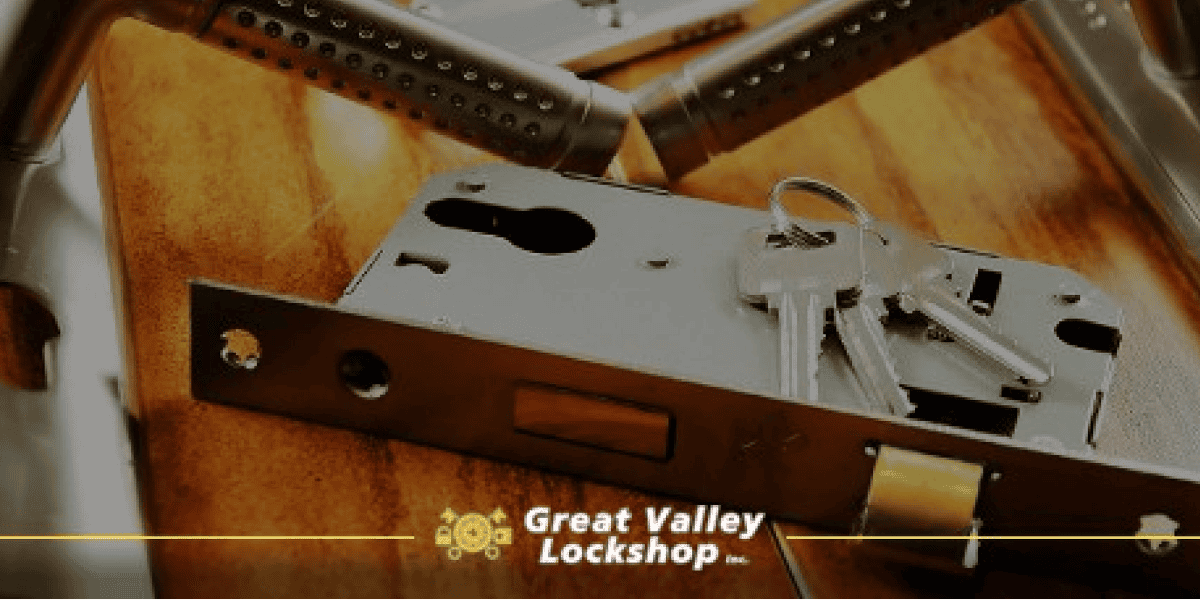
Resist the urge to replace an antique mortise lock outright. The lock body is usually solid cast metal that will outlast anything on a big-box shelf, and identifying the parts of a door lock shows which components can be serviced individually for preservation.
When a Loose Knob Is a Good Reason to Switch to a Lever Handle
Round knobs have a design limitation unrelated to wear. The U.S. Access Board notes that round door knobs fail federal accessibility standards because operating one requires twisting of the wrist.
Those standards do not govern private homes. The underlying ergonomics still apply to anyone in the household with arthritis, a healing wrist, or reduced grip strength.
Charles Odonkor, MD, a physiatrist and assistant professor of orthopedics and rehabilitation at the Yale School of Medicine, describes switching door hardware from knobs to levers as one of the most overlooked changes in a home, one that has an “incredible impact on independence, comfort, and function.”
A lever opens with a downward push from a palm, a forearm, or an elbow, and it needs no grip at all. If a knob has already failed and you are buying hardware regardless, the labor to fit a lever instead is the same. We carry lever sets from the major hardware brands and can key them to the key you already carry.
How Great Valley Lockshop Fixes Loose Door Knobs in Malvern and Chester County
Great Valley Lockshop has been working on doors in Malvern and the surrounding towns of Chester County since 1973, and a knob that will not stay tight is one of the most common calls we take.
What a locksmith brings to this job is diagnosis, not force. A technician can tell in about a minute whether the spindle is worn, whether the door core is crushed, or whether the lockset has simply reached the end of its life. That is the difference between one visit and four trips to the hardware store.
Our residential locksmith team handles:
- Lockset repair and replacement on interior and exterior doors, including matching an existing finish
- Knob to lever conversions for accessibility and aging in place
- Strike plate and latch realignment when a door has shifted with the seasons
- Rekeying so new hardware opens with the key already on your ring
- Emergency service when a handle fails, and the door will not open
We work out of 16 Church Road in Malvern and cover Chester, Delaware, and Montgomery counties.
What You Should Do Next
- Try the four-step fix above if the knob has only recently started to wobble.
- Check the spindle and screw holes if this is the second or third time you have tightened it.
- Request a free estimate or call (610) 644-5334 if the hardware is worn, the door is exterior, or the fix did not hold