Key Takeaways
1. A commercial exit door “works” only if it opens in one motion, closes on its own, and re-latches every time under real use.
2. Commercial fire exit doors matter because they create fast, single-motion egress and keep routes usable when smoke and heat rise.
3. Great Valley Lockshop installs and services commercial doors, frames, and hardware so they function on demand and remain ready in emergencies.
Why Commercial Exit Doors Matter in a Fire
Commercial exit doors matter in a fire because they slow the spread of heat and smoke, giving occupants crucial time to evacuate and ensuring that the materials used are effective. It also helps keep escape routes clear for both those leaving and responders coming in.
Moreover, modern fires can reach life-threatening conditions in 3-5 minutes, so people need an exit they can see, reach, and open in one motion. In real events, hesitation kills, making it a critical job to ensure exits are visible .
During the Station nightclub fire, smoke reached exit doorways in a little over one minute, a crowd crush formed before 90 seconds, and 100 lives were lost, despite multiple exits, all because the flow choked at the main door.
Doors and hardware turn fear into movement only if they’re apparent, single-action, and kept clear. That’s why door compliance requires releasing with not more than one motion and why workplaces need at least two remote exit routes in case one is blocked by fire or smoke.
Commercial Exit Door Code Requirements for Fire Emergencies
This guide explains the requirements for exit doors used during fire emergencies, primarily the IBC and NFPA, including egress width, swing direction, hardware (panic devices / panic bar), latching, opening force, closing/self-closing, fire ratings, and signage.
Here are the essentials:
1. Door Leaf, Frame, and Rating
A door protects life only if the entire assembly, like the leaf, frames (including hollow metal frames), glazing, and hardware, works as a single-rated unit. Use fire-rated doors in walls designed to resist fire and smoke (corridor separations, stair enclosures, rooms with higher fuel load).
A mismatched frame or field-drilled hardware can render the label fire rated doors status void. Great Valley Lockshop helps owners match hollow metal doors, frames, and listed door components so the fire rating stays valid under heat.
When owners need custom sizes rather than standard sizes, the door, frame, and hardware must still be part of a certified assembly.
2. Panic Hardware
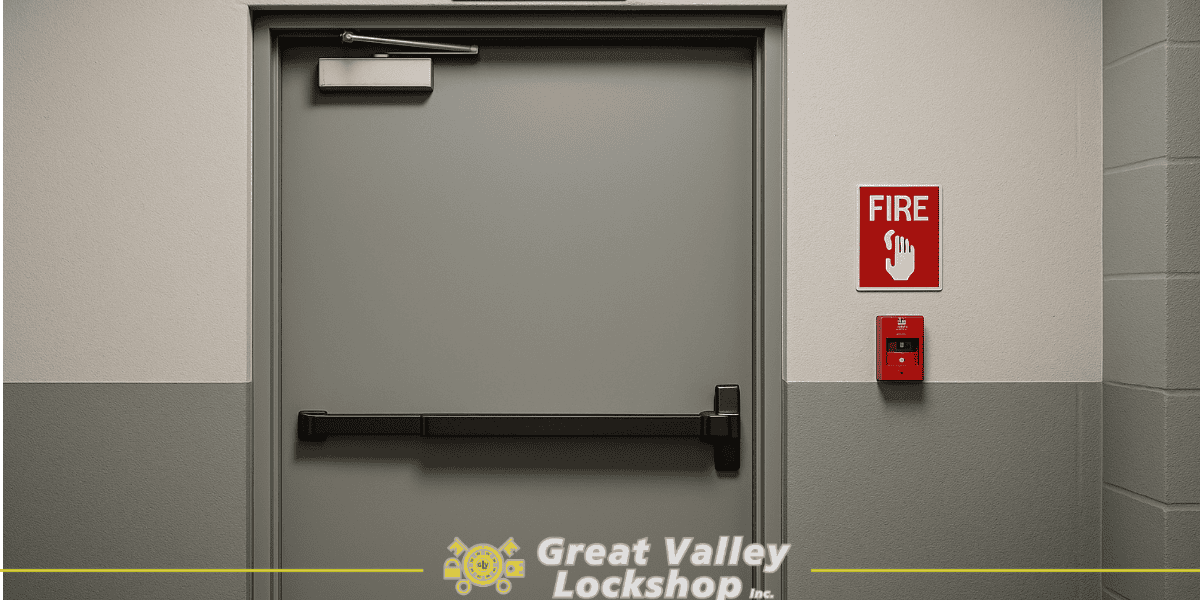
A panic hardware /panic bar is a door device that unlatches with a single push across a horizontal bar, allowing occupants to exit quickly without keys or a tight grip. It is typically required where the occupant load or use type makes crowd movement likely.
When a push bar works the same way every time, people flow rather than bunch at the threshold. Venues that replaced knobs with push bars after near-miss incidents report smoother drills and fewer doorway bottlenecks.
For new installed openings, correct hardware prep locations make future replacements simpler and code-aligned.
3. Closers and Hinges
Doors must open easily from the inside yet return to latch on their own. A closer set too strong traps minor occupants. A closer set too weak leaves the door ajar.
In one office building fire, smoke may spread through a corridor because a closet door leaked and was never latched. A simple service call would have kept the barrier intact.
Great Valley Lockshop technicians size closers to door weight and tune swing and latch speeds for smooth operation.
4. Strike Plates and Latch Engagement
“It shuts” is not enough. The latch must seat in the strike every time, or the barrier fails when pressure builds. Minor frame shifts, worn strikes, or taped latches turn a door into a hole in the wall. A quarterly “open–close–re-latch” check catches this early.
5. Clear Opening Width and Swing Direction
The opening must be wide enough for two people to pass without turning sideways, and the door should swing out in the direction everyone is moving.
When a door swings against the flow, people bunch up at the hinge side and lose seconds. When it swings with the flow, the crowd can keep moving.
For example, a small electronics shop ran a drill and saw a bottleneck at the front door. The leaf swung inward, so the first person had to step back to pull it. After the hinge was reversed to swing out, the same drill cleared the doorway smoothly.
6. Exit Signage and Lighting
People follow light and simple cues. Signs must be bright and easy to spot from anywhere on the floor; lighting should mark the route at eye level and near the floor.
In smoke, people look low. A bright sign and a lit path reduce hesitation and wrong turns.
7. Fire-Rated vs. Egress Requirements
Not every exit door is fire-rated, especially when it comes to fire doors. Every exit must open in one motion and stay usable under stress. A fire-rated door is only required where the wall or stair is part of a rated barrier that must hold back fire and smoke.
For example, the front door of a boutique may not be fire-rated, but it still needs panic hardware that unlatches with a single push. The stair enclosure door is part of a rated barrier, so that door, frame, and glazing must be a listed fire-rated assembly that closes and latches on its own.
Where doors are altered, owners should confirm whether they must re certify the opening, especially when changing glass or hardware.
8. ADA Notes
Doors should be easy to open, and there must be clear space on both sides so that everyone can. Children, older adults, and customers using a cane, walker, or wheelchair should get through without help, including custom sizes to accommodate varied accessibility needs.
The bar or lever moves with steady pressure, the door swings freely without scraping the floor, and there is room to approach, pull or push, and pass through without tight turns. For high-traffic facility or industrial settings, adding a kick plate or intermediate rail improves durability and visibility.
Simple Inspection Checklist
| Checklist item | Yes / No |
|---|---|
| Exit route is clear from inside to outside | ☐ Yes ☐ No |
| The door swings freely without scraping or binding | ☐ Yes ☐ No |
| Panic bar releases the latch in one motion | ☐ Yes ☐ No |
| The door closes on its own and re-latches without a shove | ☐ Yes ☐ No |
| Hinges are tight and not wobbling | ☐ Yes ☐ No |
| The strike plate is aligned and not bent or worn smooth | ☐ Yes ☐ No |
| The door closer shows no leaks and no missing screws | ☐ Yes ☐ No |
| Closer speed is tuned so the door does not slam or drift | ☐ Yes ☐ No |
| The exit sign at the door is illuminated | ☐ Yes ☐ No |
| Emergency lights at the door test successfully | ☐ Yes ☐ No |
| Exit door alarm or contact activates when opened | ☐ Yes ☐ No |
| No props or wedges are used to hold the door open | ☐ Yes ☐ No |
| Weekly walk-through and push-test completed | ☐ Yes ☐ No |
| Annual professional service scheduled and completed | ☐ Yes ☐ No |
| Pro service verified closer settings and latch engagement | ☐ Yes ☐ No |
| Pro service verified panic hardware operation | ☐ Yes ☐ No |
| Pro service checked signage and emergency lighting | ☐ Yes ☐ No |
| Any failed parts were repaired or replaced promptly | ☐ Yes ☐ No |
| Maintenance log updated with date and location | ☐ Yes ☐ No |
| Work orders and invoices filed with the log | ☐ Yes ☐ No |
| Quarterly review of the log is done to spot recurring issues | ☐ Yes ☐ No |
Great Valley Lockshop Product & Service Fit
Great Valley Lockshop, along with various manufacturers, provides commercial door installation and egress/exit doors & devices, including:
- Panic/crash bar doors
- Storefront doors
- Steel/wood frames (including hollow metal frames for rated openings)
- Glass doors
- Automatic and ADA operators
- Closers
- Strikes
- Master keying/rekeying
- Keyless/biometric access and other commercial security systems
You get code-aligned recommendations (ALOA/NFPA aware), clean installation, and prompt timelines backed by 24-hour emergency call service.
Our team repairs damaged doors and panic bars at your facility, provides emergency board-up for broken glass, and serves as a factory-authorized repair center for leading brands (e.g., Yale, Norton, Rixson). Commercial security coverage includes Pennsylvania, Delaware, Maryland, and New Jersey.
Where owners prefer wood or architecturally finished doors (e.g., cherry or stained interiors) for front-of-house but still need code performance at the stairs, Great Valley Lockshop can separate decorative doors from rated stair door assemblies.
If you need guidance aligned with industry standards and compliance, we can reference the Steel Door Institute’s guidance on hollow metal assemblies for fire rated openings.
Get on a call with us to know more.
Commercial Exit Door Safety With Great Valley Lockshop
When exits are obvious, single-motion, and kept clear, crowds move; when they’re blocked or confusing, people stall, and conditions overtake them. The Station nightclub fire shows how fast things deteriorate. Within roughly a minute, smoke was already in the exit doorways, and a crush at the main entrance nearly stopped the flow, contributing to 100 deaths.
Today’s enforcement actions tell the same story from everyday businesses. Inspectors continue to find chained or obstructed exits, which regulators stress is why “seconds matter” in emergencies.
How Great Valley Lockshop helps
- Right doors and devices. Installation and repair of exit doors and panic (crash) bars, plus closers, strikes, and frames, so doors open in one push and re-latch reliably.
- Code-aware service, fast response. Recommendations aligned with ALOA/NFPA practices, clean installs, and 24-hour emergency support for damaged doors, failed commercial door hardware, or board-ups.
- Ongoing reliability. Inspections, adjustments, and factory-authorized repairs that keep openings operable and documented.
Book a short exit-door assessment with Great Valley Lockshop to verify that every critical door opens in one motion, closes, and latches.