Key Takeaways
1. An access control system replaces mechanical keys with electronic credentials, so you can grant or revoke one person’s entry in seconds instead of rekeying a building.
2. The software is the easy part because every electrically locked door in an exit path must meet fire code and accessibility requirements that a card reader alone cannot address.
3. Great Valley Lockshop has installed door hardware behind access control systems at its Malvern shop since 1973 and works alongside access system contractors across Chester County to get openings right the first time.
What Is an Access Control System for a Commercial Building?
An access control system is a set of electronic locks, readers, and management software that decides who can open each door in your building and records every entry. The same phrase also describes user permission models in software, which is a different subject entirely. This article covers the physical kind, meaning the doors and hardware in your facility.
For a business owner in Malvern or Frazer, the practical value is simple. An employee leaves on Friday, and their credentials stop working on Friday. Nobody changes a lock, and nobody wonders how many copies of a key are still out there.
That matters more than most owners expect. CISA defines an insider as someone who, intentionally or not, uses authorized access to harm an organization’s people, facilities, information, or equipment. A key you cannot account for is exactly that kind of exposure.
Here is what a business actually buys, and who normally supplies each piece.
| Component | What It Does | Who Usually Supplies It |
|---|---|---|
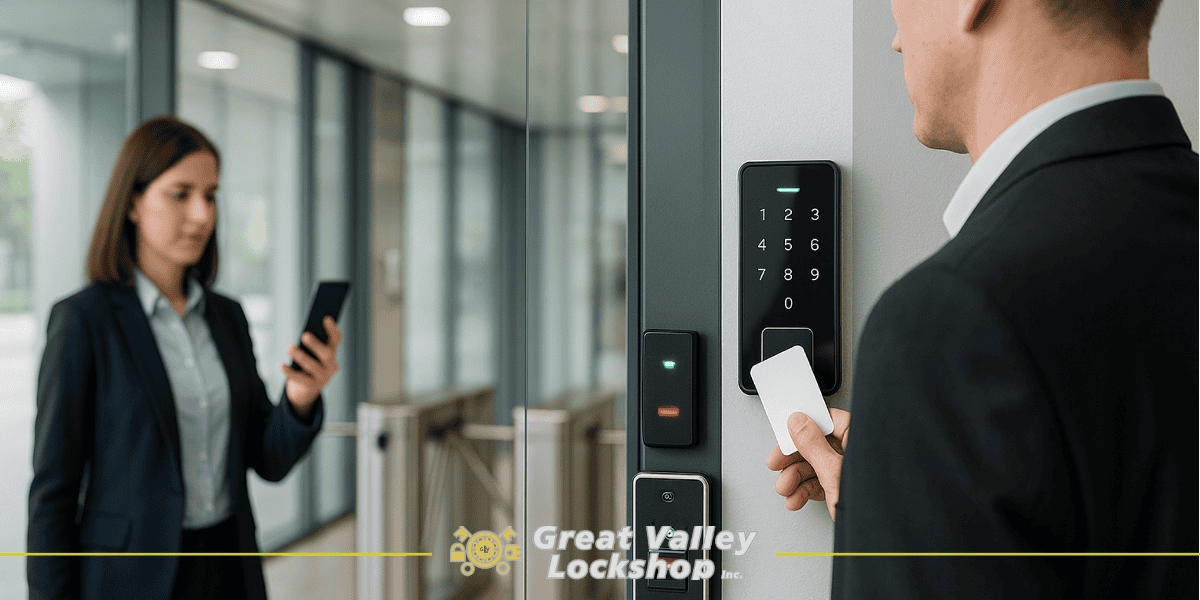
| Credential and reader | The fob, card, PIN, phone, or fingerprint, plus the device that reads it | System vendor or security integrator |
| Controller and low-voltage wiring | Makes the lock or unlock decision and carries power to the door | Integrator or low-voltage contractor |
| Electrified door hardware | The electric strike, electrified lockset, exit device, or magnetic lock that physically holds the door | Commercial locksmith |
| Management software | Where you add users, set schedules, and pull the audit log | System vendor, cloud, or on-premises |
Notice the third row. The vendor sells you the first, second, and fourth. The door itself is a separate trade, and it is where most access control projects go wrong.
Which Access Control System Fits Your Business?
Match the system to your door count and your staff turnover, not to the feature list. Most Chester County businesses fall into one of three tiers, and moving up a tier before you need to is the most common way to overspend.
| System Type | Best Fit | Trade Off |
|---|---|---|
| Standalone keypad or lock | One to three doors, stable staff, single site | No central audit trail, codes are managed door by door |
| Networked on premises | Several doors, one building, IT staff on hand | Higher upfront cost, you own the server and the updates |
| Cloud managed | Multiple sites or frequent staff changes | Ongoing subscription, depends on your network |
A few practical notes:
- Credential type is a separate decision from system type. Key fobs and cards, phone credentials, and biometric readers can run on most modern platforms.
- Start with the doors that carry real risk. Server rooms, records storage, pharmacy and lab space, and cash handling areas earn a reader before a break room does.
- Confirm your controller has spare capacity. Panel capacity is the most common reason a three-door project becomes a six-door project in year two.
What does the Pennsylvania Code require of an Access-Controlled Door
Any electrically locked door that people also exit through is regulated life safety hardware, not just a security choice. NFPA 101 section 7.2.1.6.2 and International Building Code section 1010.2.12 both set conditions that a sensor-released electrically locked egress door must meet, and a fire inspector will check them.
For a door where the lock releases on a sensor, the arrangement generally has to include all of the following:
- A sensor on the exit side that unlocks the door when it detects someone approaching
- A manual release device within 5 feet of the door, labeled “push to exit,” that cuts power to the lock for at least 30 seconds.
- Automatic unlocking on loss of power
- Automatic unlocking on fire alarm or sprinkler activation, staying unlocked until the system is manually reset
- Locking hardware listed to ANSI/UL 294, the standard for access control system units
Not every reader triggers these rules. The sections apply to locks that a sensor releases when it detects someone approaching. A reader paired with an electrified lockset or panic hardware that still allows free egress by operating the lever or push bar is a different arrangement with different requirements.
Accessibility applies at the same opening. The 2010 ADA Standards require that door hardware operable parts be located between 34 and 48 inches above the floor, and that they be operable with one hand without tight grasping, pinching, or twisting.
A card reader also counts as an operable part, with an unobstructed reach range of 15 to 48 inches. Readers mounted too high are among the more routine corrections made to otherwise finished installations.
Two things changed recently. Pennsylvania moved to the 2021 International Codes effective January 1, 2026, and the transition window for projects contracted under the previous edition closed on July 1, 2026. If your access control project was scoped in 2025 and shelved, it is now being reviewed against a different code.
Who reviews it also varies by township. More than 90 percent of Pennsylvania’s 2,562 municipalities enforce the Uniform Construction Code locally, through their own code official or a certified third-party agency, while the rest default to the state Department of Labor and Industry for commercial work. A project in Malvern Borough and the same project in a neighboring township can land on two different desks.
This is the part that makes access control a poor do-it-yourself project. Ordering a magnetic lock online is easy. Proving to an inspector that the opening releases on power loss, on alarm, and on a labeled manual device is a separate job, and a failed inspection can stop your certificate of occupancy.
How Does an Access Control System Work?
What Drives the Cost of an Access Control System
Cost tracks the condition of your doors far more than the price of the software. Two buildings with identical reader counts can differ substantially once someone opens the frames.
The variables that move a quote most:
- Door and frame condition. An old wood frame or a narrow stile aluminum storefront may need prep work, reinforcement, or replacement before it will accept an electric strike.
- Wired against wireless. Running low-voltage cable through finished masonry costs real labor. Wireless locks avoid that and trade it for battery maintenance.
- Credential technology. Keypads sit at the low end and biometric readers at the high end, with cards, fobs, and phone credentials in between.
- Licensing model. Cloud platforms shift spend from upfront hardware to a recurring subscription, which changes the five-year picture more than the first invoice suggests.
- Door count. Controllers and power supplies are shared, so the per-door figure usually improves as the project grows.
Budget for the system’s second decade. Access control equipment generally needs replacing every eight to ten years, and setting aside part of an annual facilities budget beats an emergency replacement.
Credential expiry costs nothing and gets skipped constantly. Set credentials to lapse on a schedule, roughly every six to twelve months for staff and every two to three months for contractors, so forgotten access closes itself.
Why Malvern and Chester County Businesses Call Great Valley Lockshop
Great Valley Lockshop opened in 1973 as part of Great Valley Hardware and was one of the only commercial locksmith companies serving the Malvern and Frazer area at the time. The shop operates today from a 2,500-square-foot building at 16 Church Road in Malvern, a block off Business Route 30, with a showroom you can walk into.
Our specialty in access control projects is the row most vendors do not cover. We work alongside security companies and access system contractors to install the mechanical and electrical locks that make a new system actually function on the door, and we supply the hardware we install.
That extends to the openings inspectors scrutinize most closely. We handle exit doors and panic hardware, delayed-egress arrangements, and door-lock compliance for businesses that must satisfy both security requirements and fire code. Our wholesale division, Frazer Lock and Supply, has provided factory-authorized repair for major lock manufacturers since 1985.
Mobile service runs about 80 miles from Malvern, covering Chester, Delaware, Montgomery, and Philadelphia counties, and our commercial crews work across eastern Pennsylvania, Delaware, Maryland, and New Jersey. Tell us about your building, and we will tell you what your doors can accept.
What You Should Do Next
- Walk your building and list the doors that hold real risk, then note which are in an exit path, because those carry code requirements, the others do not.
- Ask every vendor the same two questions. Who installs the door hardware, and does the quote cover the electric strike, frame prep, and inspection support, or only the reader and software?
- Request a free estimate from Great Valley Lockshop, or call the Malvern shop at (610) 644-5334 to have a technician assess what your existing doors and frames will support.